
Cleaning for schools and educational centers
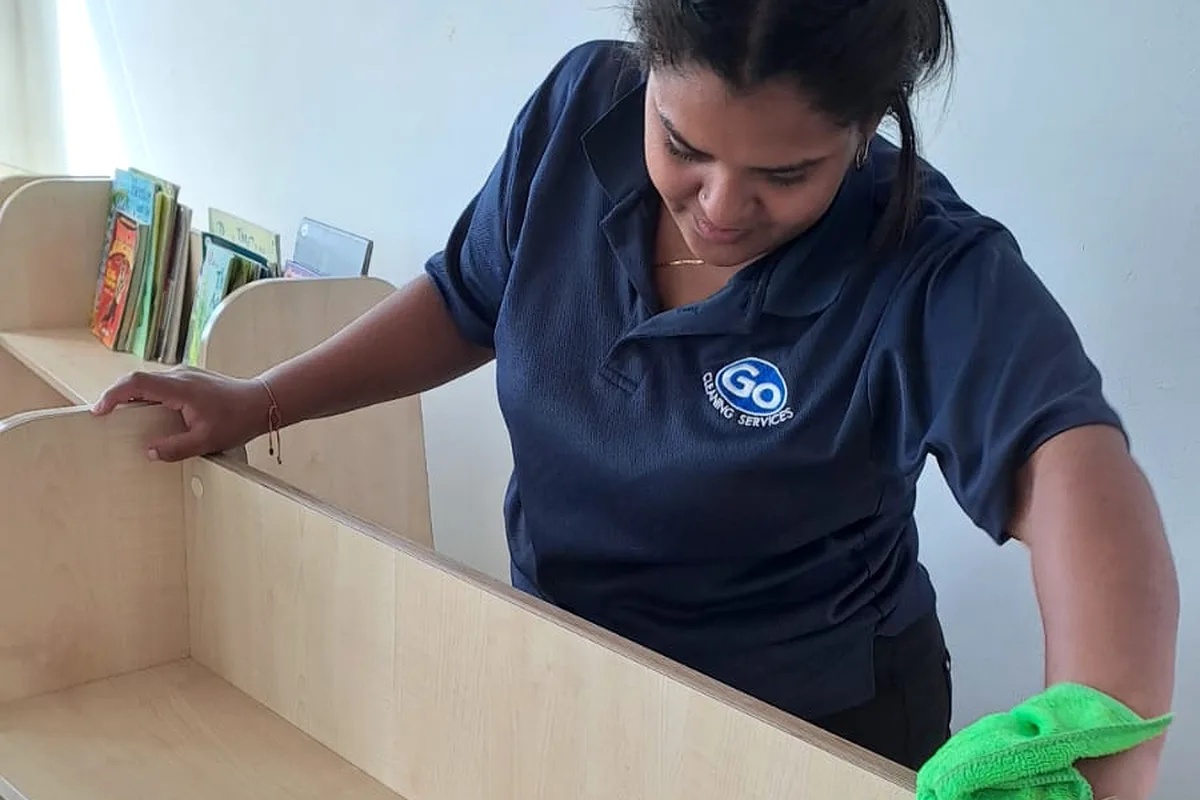
The cleaning protocol for an educational facility, zone by zone: what is done, with which products and when.
Cleaning a school cannot use the same chemicals as an industrial warehouse. Products must be low-toxicity, free of strong odors and safe for indirect contact with minors, and the work has to finish before students arrive. This page explains how that work is organized.
Go Services applies a biofriendly protocol as an included standard, on schedules outside class hours. If you run a school, a college or a university and need to decide how to contract cleaning, that guide is at school and campus cleaning.
What does cleaning an educational facility include in each zone?
Each zone of a school has a different use, risk and frequency. These are the four that change the protocol most.
Classrooms and hallways
These are the highest-traffic surfaces: desks, door handles, switches, railings and handrails. They are cleaned daily, with disinfection of the high-touch points, and the floor is done last so that nothing already clean gets dirty again.
Restrooms
They are the school's highest hygiene risk. They call for daily disinfection of toilets, sinks, fixtures and floors, with tools dedicated to this zone that are never used in classrooms or cafeterias.
Cafeterias, school kitchens and water fountains
Here the cleaning is designed around food and water. The working rule is to keep food-contact surfaces separate from everything else, to use products suited to these zones and to leave no residue or odor.
Sports areas and locker rooms
Covered courts, gyms and locker rooms combine sweat, humidity and street footwear. They call for cleaning suited to the floor material and disinfection of benches, lockers and showers, with ventilation so humidity does not encourage mold.
Why do low-toxicity products matter in a school?
Children spend the day in contact with desks, floors and handles, and breathe in enclosed spaces, so strong products carry a cost that a warehouse does not have. A biofriendly protocol uses low-toxicity products without strong odors, which disinfect without leaving active chemical residue when students return.
That does not replace sound use: each product's technical data sheet sets the dilution, the contact time and where it can be applied, and those instructions are followed in every zone.
What is cleaned daily and what is done in depth?
Daily cleaning keeps the school running between classes. Deep sanitizing covers the highest-risk zones at an agreed frequency, and school breaks allow the work that cannot be done with students present:
- Daily. Classrooms, hallways, restrooms and high-touch points.
- At an agreed frequency. Cafeterias, school kitchens, water fountains, sports areas and locker rooms.
- During breaks. Work that needs empty spaces, such as floor treatment or window cleaning.
For that work, the detail is under floor care and windows and facades.
How are schedules organized so classes are not interrupted?
The rule is that the school is clean before students arrive and that the work never overlaps with classes. So the service is scheduled for the evening or the weekend, depending on how the facility operates, and coordinated with administration so that each zone is ready on time.
How is the work verified?
Each zone has its checklist and the team hands in a report for each shift, so administration can confirm what was cleaned and when without having to supervise in person.
Request an assessment of your facility
The right protocol is defined by walking the grounds. Tell us which zones your facility has and when it operates, and we will assess how to organize the service.
Request an assessmentSpotless facilities, frictionless operations.
Message us on WhatsApp